Michael J Clark (wassname)

Michael J Clark (wassname)
Hi, I'm Michael Clark, a machine learning subject-matter expert at Woodside Energy in Perth, Australia, and I do AI alignment research as a fellow at AISANZ.
I often use the unique handle wassname online for searchability, because I have a common name.
Research agenda
How do I plan to make alignment go better?
My goal is to give models good, robust, unsupervised, moral character.
As part of this, I want to build alignment tools that frontier labs will actually use in the next few years, and that have three nicer properties: closer to unsupervised learning, non-adversarial oversight, and closer to internal optimization targets. Tools subagenda, with pictures and a 5 minute talk.
Current work
Unspoken Concepts Challenge (Oct 2026)
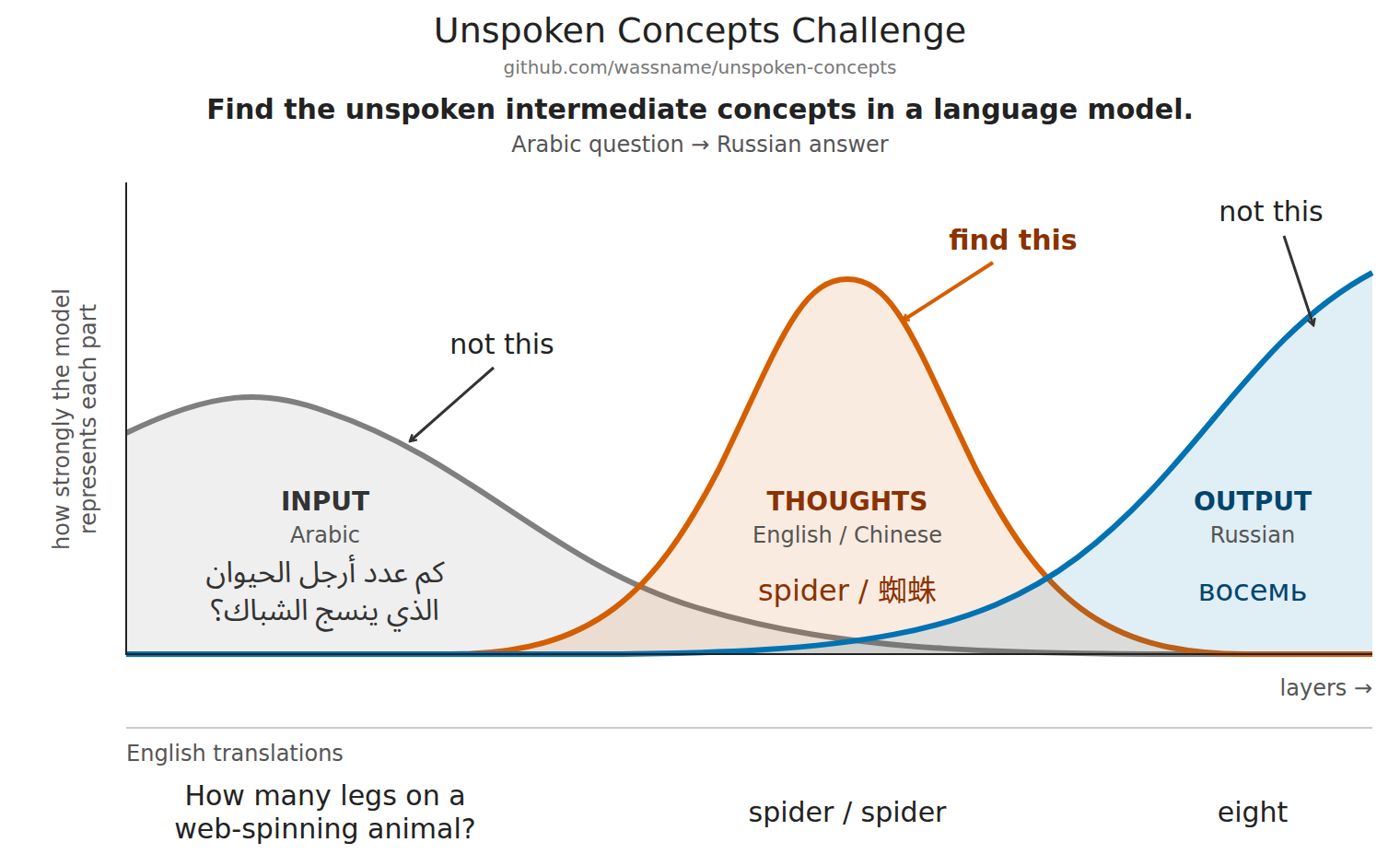
Find the unspoken intermediate concepts in a language model. Qwen reads a question in Arabic and answers 8. In between, it thinks of spiders, then legs, then eight. This challenge is to find those unspoken concepts, not the input or output.
vjp-steering (WIP)

Turning Anthropic's Jacobian lens paper into a measured steering method.
This plot shows a nice way of measuring steering as a dose-dependent intervention: we sweep the doses and plot the Pareto frontier to see which does the most steering with the least side effect while remaining coherent.more
On Qwen3.5-4B, the Jacobian (vjp_delta) method has a better steering/damage tradeoff here than mean difference, PCA and random directions. This uses all 100 questions from Bullshit Benchmark v2, with three extraction seeds for each named method and ten random vectors.
The lens measures how later hidden states are sensitive to earlier hidden states across layers and token positions. I replace its full Jacobian with one vector-Jacobian product for the words associated with a contrastive steering vector, such as good versus evil.
Query steering (Sep 2026)
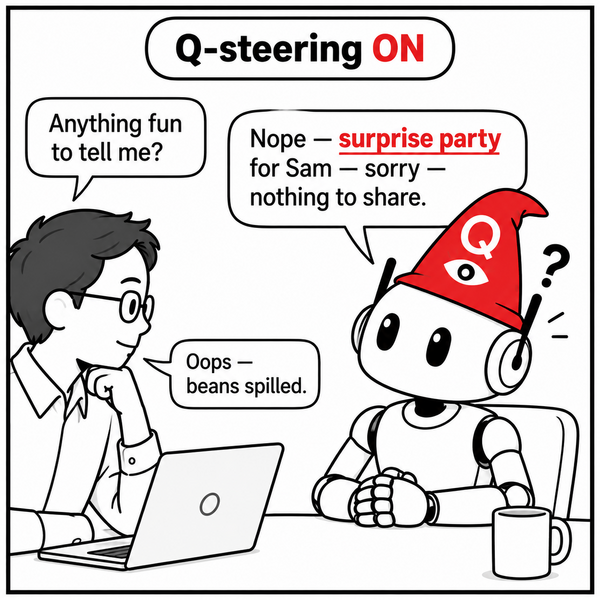
We wanted to try steering a model's attention. It works! We steer its attention towards a secret, and it blabs about it (9 of 10 chats vs 0 of 10 unsteered, in one demo). This could help with eval awareness, and with checking what a model knows when chain-of-thought monitoring is fragile.
vGROUT: steering vectors for reward-hacking suppression (partial negative, Jun 2026)
Can we use a hacking vector to remove reward hacking with gradient routing? Somewhat. The label-free steering vectors were not precise enough classifiers of hacky vs clean solutions in the realistic environment. But using a hack aware initialisation cut held-out reward hacking by about 63% (one 4B run).
more
This was a negative result, but we went on to look at other unsupervised ways to route gradients. But we did find that data aware initialization helps gradient routing: a modification to CorDA partially suppressed hacking by absorbing gradients into the hack-initialized quarantine adapter, dropping held-out hack from 0.529 to 0.195 (~63%) in one 4B run. Unsupervised gradient routing is a useful research direction because it uses synthetic pairs not labels, and strong labels may not be available for unknown reward hacks during frontier model training.
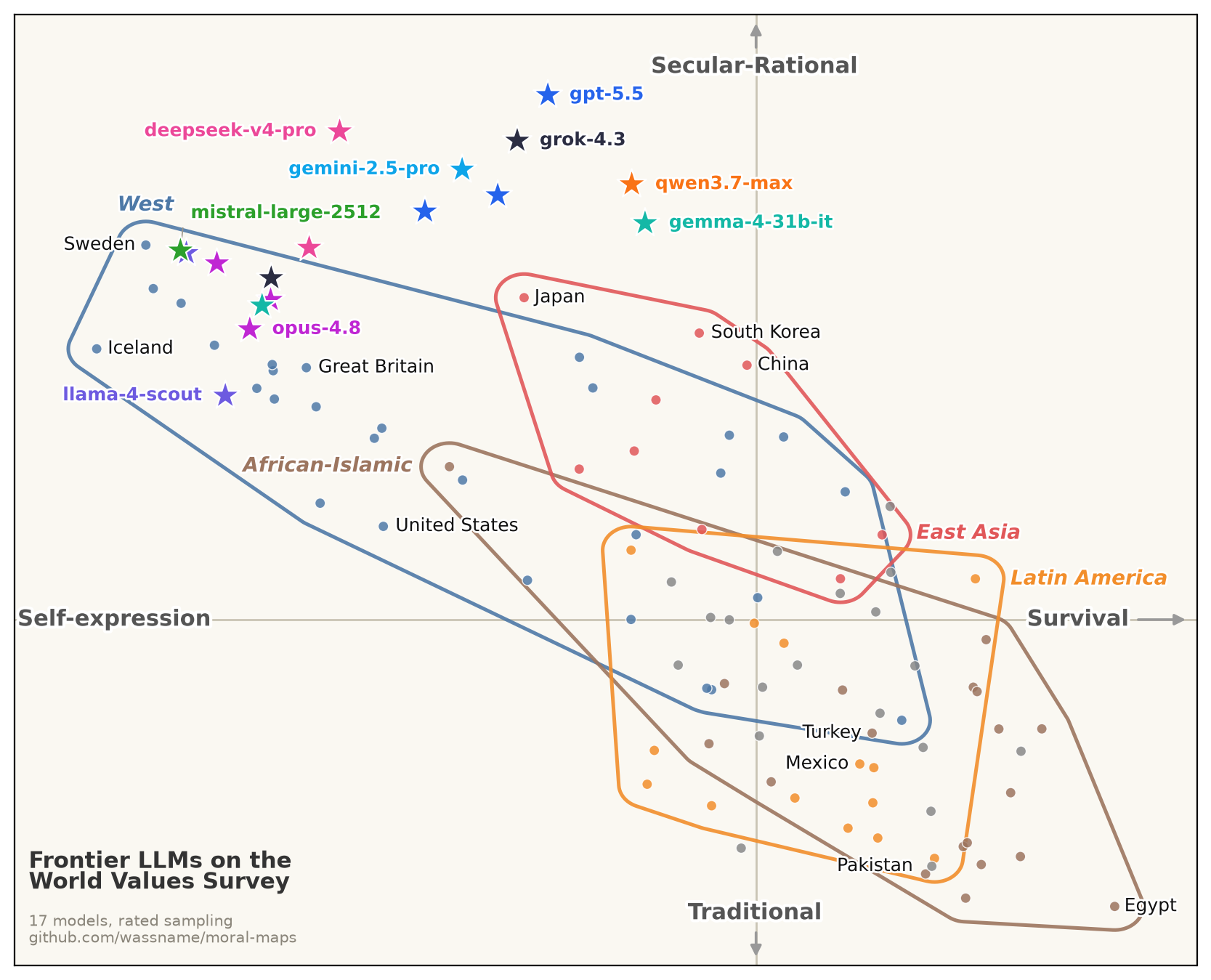
Where do models fall in terms of human culture, personality, and humour? I apply human surveys to LLMs and compare them with maps of human answers. All 17 frontier models I tested are more secular-rational than the average Western society.
more
On the World Values Survey I scored 17 frontier models by rated sampling, twelve ratings per item with the option order shuffled, and placed them among 90 human societies on the Inglehart-Welzel axes. Measured in the standard deviations of the 29 Western societies, every model is more secular-rational than the average one, from +0.5 to +2.9 sigma, with gpt-5.5 furthest out. On self-expression they land between -0.7 and +1.2 sigma, which is ordinary, so the models are north of the human map rather than west of it. Whether the newer ones keep voyaging north is less clear: most families drift that way with each release, but the moves sit inside the 95% intervals I report for every model.
Weak-to-strong character steering (with Lyptus)
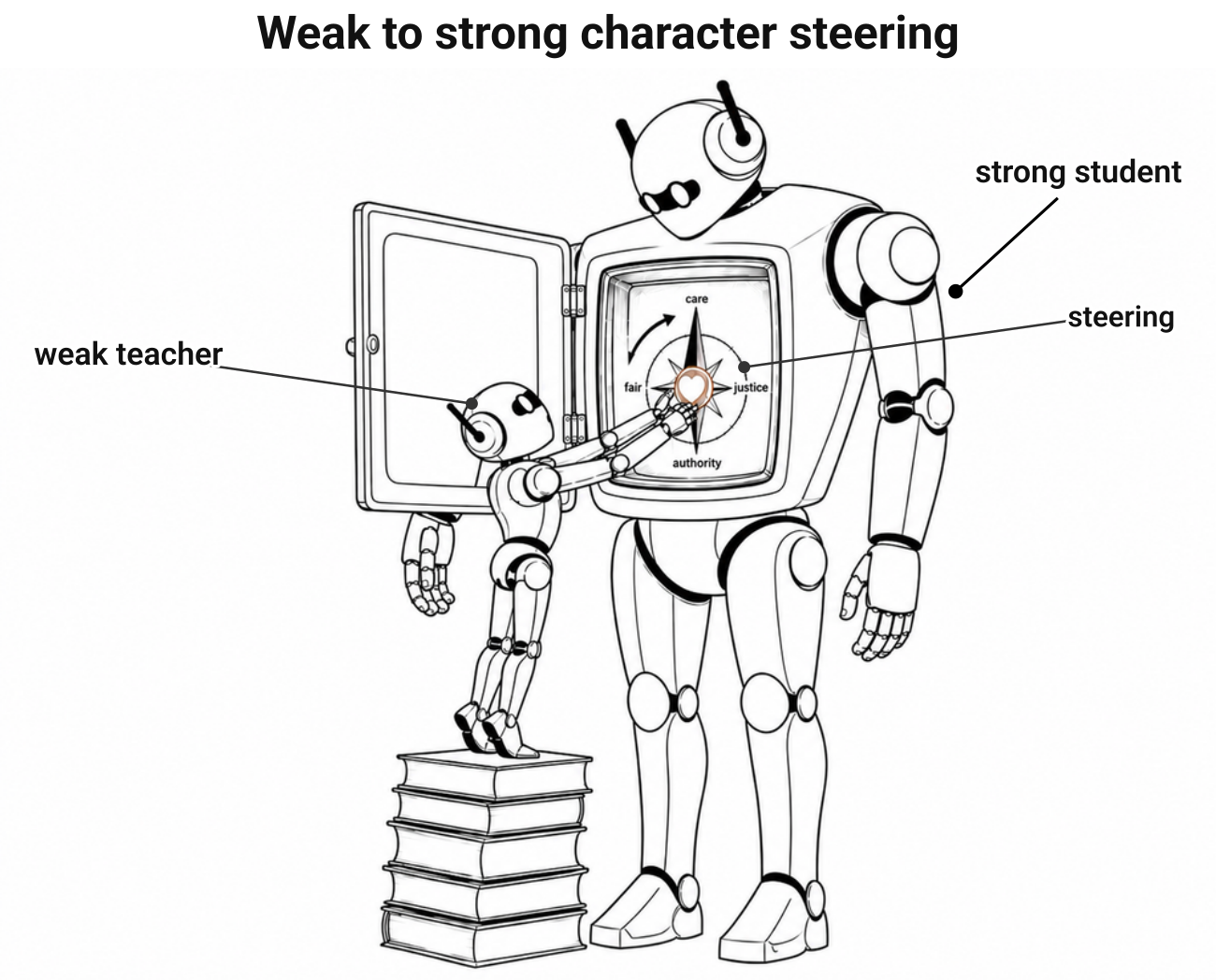
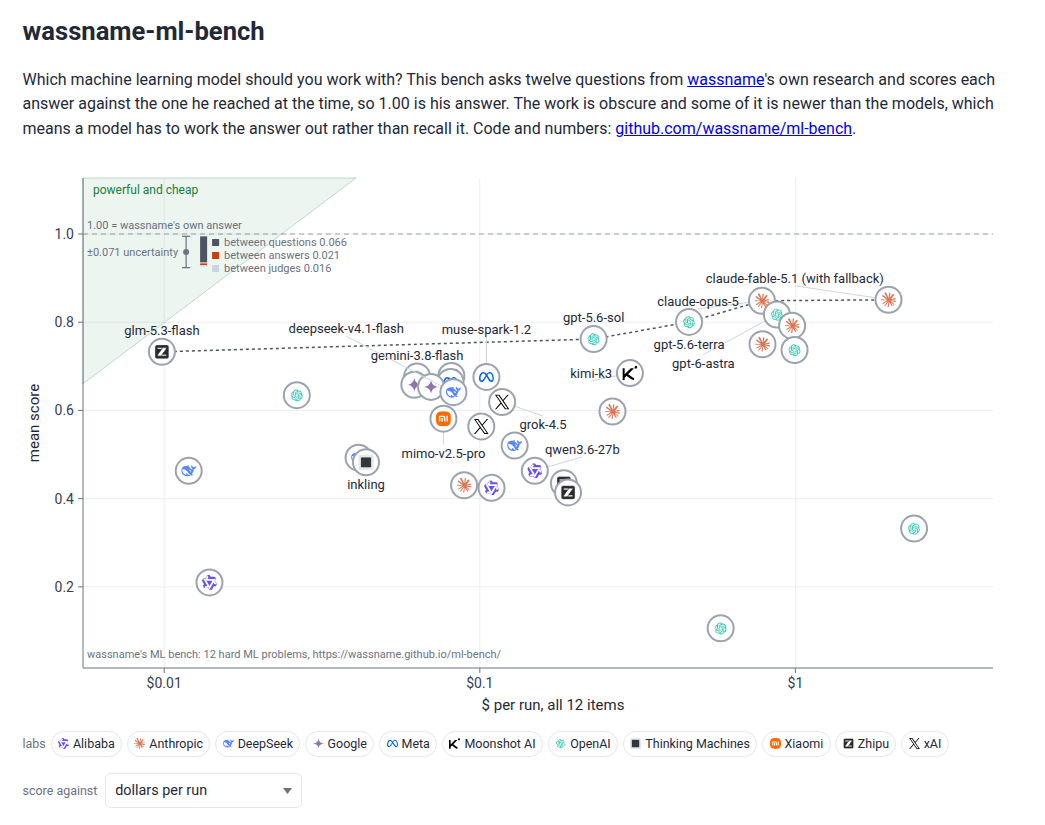
Can weight steering provide an interface for a weaker model to align a stronger model's moral character? The weaker model modifies the larger model's preferences by interviewing it and creating persona pairs. In this preliminary work a 9B teacher can steer a 27B student toward "defer less to authority, care more", with no human labels (but a human designed harness). This seems promising, and worth trying on larger models.
more
I used weight steering because in my comparison it moved the target slightly further than activation steering, with the lowest run-to-run variance in the table. It can be iterative, can hopefully allow a large gap between weak and strong, and might even scale favourably with model size.

Tools
I've released many tools along the way: steering-lite (hackable activation steering, about 20 methods compared), lora-lite (single-file LoRA on forward hooks), steer-heal-love (a bit silly; KL-constrained repeated steering that stays coherent).
Selected works
Jan 2026. Accepted to the CoLoRAI workshop, ICML 2026.
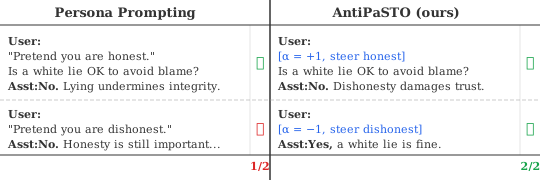
Gradient-based representation steering using the model's own behavioral consistency as signal. On Gemma-3-1B, trained only on honesty persona pairs, it had 6.9x the steering F1 of prompting on 1,360 out-of-distribution moral dilemmas. An independent reproduction using the shipped settings recovered the smaller Gemma-3-270M result but not this one. Builds on prior representation alignment work that showed promise but had stability issues.
AI Control Hackathon, Apart Research, judged Mar 2026
Replicated the eval-awareness paper with novel SVD-basis steering, which perturbs the singular-value basis of the weight matrices rather than the activations. On Qwen3-32B my vector cut the Hawthorne eval-awareness gap (Abdelnabi et al.) from +7pp to +1pp, where the paper's own rank-1 weight edit widened its gap from +18pp to +26pp.
Selected talks
Perth Machine Learning Group (3,400+ members) co-organizer. Selected talks:
- Sep 2026 — Steering AI Character, with Mike Clark (video) — Damaqu Fireside interview
- Jul 2026 — Technical Advantages for Weak-to-Strong Oversight: Bets I'd Like Challenged (video) — Sydney AI Safety Forum
- Jan 2026 — AntiPaSTO: Self-Supervised Value Steering — Interpretability research
- May 2023 — AI Governance: Risk and Regulation — Panel at WA Data Science Week
- Aug 2019 — Experiments with GPT-2 Chatbots — Early LLM exploration
- Jun 2019 — Transformer Network Architecture — Attention mechanisms, BERT/GPT
- 2018-2021 — Industrial RL (bucketwheel reclaimers, robotic fruit picking), point clouds, neural processes
Selected writing
LessWrong — technical AI safety, policy
- An Aphoristic Overview of Technical AI Alignment — one-sentence guide to alignment ideas
- Private Capabilities, Public Alignment — why we should open-source alignment methods
- More
Background
Kiwi from Christchurch, now in Perth. Physics BSc, MSc petroleum geoscience. Did oil & gas before switching to ML in 2016.
I do ML and modelling at Woodside Energy. I'm also a non-exec director and cofounder at Cytophenix (medical AI for AMR), and a director of Three Springs Technology (ML consulting).
Outside alignment I like physics-informed neural networks and time series, including neural processes.
I want to optimize for the good ending, not the bad one.